


Chemistry is vital in construction for time management, quality and sustainability. In Europe, there’s a focus on eco-friendly practices, such as using local, low-carbon materials, emphasizing insultation and renewable energy. To support
future reuse, construction materials should be low in harmful substances, documented for recyclers.
WHY TOX-FREE, CIRCULAR AND CLIMATE NEUTRAL IN THE BUILDING SECTOR?
ABOUT THE AWARD
The NonHazCity Building Award is the first policy prize recognizing best policies in construction in the Baltic Sea Region at national, regional or local level.
It aims to highlight policies protecting people and the environment from hazardous chemicals in buildings, integrating circularity, toxic-free & climate neutrality. The aim of the award is to inspire citizens, decision-makers and
businesses and to showcase innovative solutions. The World Future Council coordinates and bestows the award as part of the EU Interreg Project NonHazCity 3.
In addition to identifying exemplary policies, a core objective of the award is to foster mutual learning and collaboration among countries and regions facing diverse challenges. The participating countries differ significantly in
their economic capacities, size, geopolitical challenges and history. Acknowledging this diversity, the award structure includes two distinct but equal categories:
– An Impact Award honours policies with robust chemical regulation, a strong implementation record, and measurable success in reducing hazardous substances
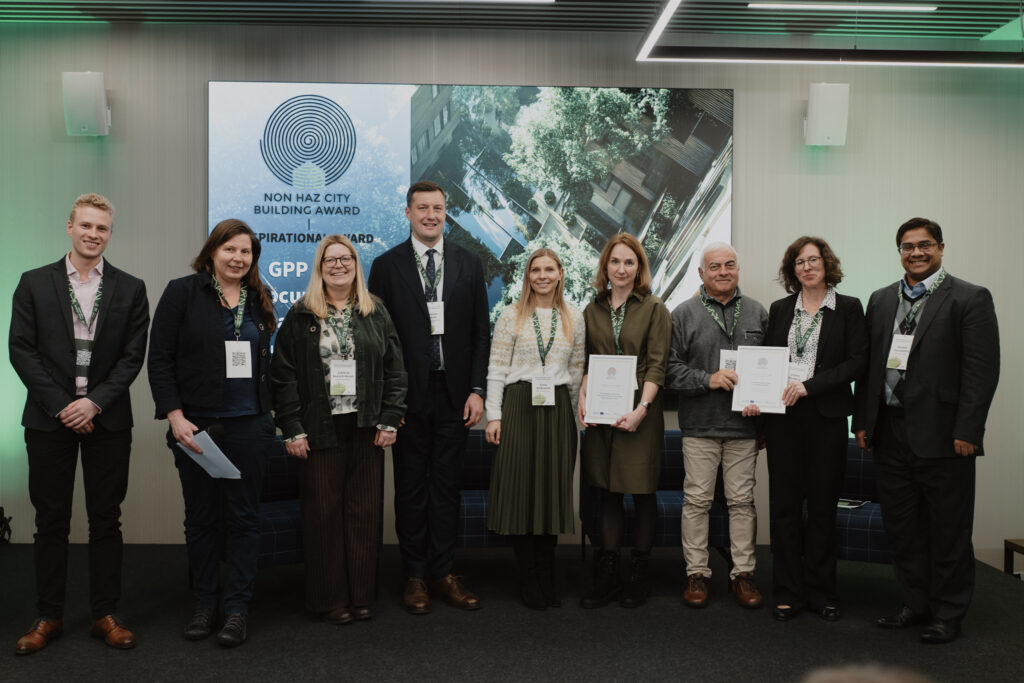
– An Aspirational Award recognizes ambitious policies with a high potential. These may be recently adopted or address non-hazardous construction as part of a broader strategy
– Additionally, there will be three Honourable Mentions
PROCESS
The Selection Process
A total of 16 nominations were received during the call for submissions in summer 2024, 9 of which were found eligible according to the selection criteria. These nominations were evaluated in detail
over the winter of 2024/2025 by a research team that reviewed legal documents, implementation records, supporting materials, and conducted interviews with key stakeholders and policymakers. The assessment criteria included the strength
and clarity of chemical regulation, consistency of implementation, demonstrable impact, and potential for replication across other regions. More details on the shortlisted nominations can be found in the related
press release.
The winners were selected in May 2025 by an international jury of seven members, composed of experts from various professional fields, including academia, environmental NGOs, a consumer association, politics, a municipal
cooperation network, and a sustainable construction assessment body.

COORDINATING PARTNER
The World Future Council brings the interests of future generations to the centre of law and policy making. The Council addresses challenges to our common future and identifies and promotes effective legislative and
policy solutions among decision makers.
www.worldfuturecouncil.org

The NonHazCity 3 project focuses on the building sector and involves architects, construction companies, consultants, municipalities, and private individuals in the project.
The NonHazCity 3 project addresses the link between circular economy, climate neutrality and smart procurement in building materials. More than 20 partner entities from eight different countries across the Baltic Sea Region are learning
from collaboration with each other to raise awareness of hazardous substances in construction material. The project is led jointly by Riga City Council and the NGO Baltic Environmental Forum BEF.

